Jacketed Glass Reactor Temperature Control: Thermal Lag, Mixing and Cooling Design
2026-10-20 14:14:16The jacket setpoint is not the reaction temperature
A circulating heater or chiller may show a stable setpoint while the contents of a jacketed glass reactor remain several degrees away from the process target. That difference does not necessarily mean the circulator is faulty. Between the setpoint and the bulk liquid are the circulating fluid, hosework, glass wall, heat-transfer film and a moving reaction mixture. Each part adds thermal resistance, thermal capacity or measurement delay.
This distinction becomes especially important when a batch changes viscosity, receives a cold feed, produces reaction heat or switches from heating to cooling. At OLLITAL, we recommend treating temperature control as a complete reactor-and-utility design rather than choosing equipment from a circulator temperature range alone. The procurement question is not simply whether the display can reach a specified value, but whether the *actual product* can follow the required time-temperature profile under the intended load.
1. Separate the four temperatures that operators often confuse
A good process review identifies at least four locations: the circulator supply, the jacket inlet, the jacket outlet and the bulk liquid measured by a correctly located probe. Some systems expose only one or two of these readings. That is sufficient for routine operation of a validated recipe, but it can make root-cause analysis difficult when heating is slow or cooling overshoots.
Circulator setpoint is a controller target, not measured heat transfer. Jacket supply temperature describes the utility entering the vessel. Jacket return temperature can provide evidence of heat exchange when flow and sensor positions are known. Bulk product temperature is ordinarily the most relevant reading for reaction quality and safety. Their differences will change through the batch; no fixed offset should be assumed for every product or scale.
A temperature probe placed close to the wall, above the liquid level or near a concentrated feed stream can report a local condition rather than the bulk average. Probe immersion, calibration, response time and compatibility with the operating fluid therefore belong in the commissioning plan.
2. Why thermal lag increases as the batch gets harder to mix
The jacket must warm or cool the vessel wall before energy reaches the material. In a low-viscosity, well-stirred liquid, circulation within the product can reduce internal temperature differences. As viscosity rises, the same stirrer speed may no longer provide adequate turnover, so wall-adjacent liquid responds faster than poorly circulated regions. Large additions or high-solids slurries can cause additional transient gradients.
For a first engineering estimate, heat required for a sensible-temperature change depends on batch mass, heat capacity and temperature difference. The time required additionally depends on the usable heat-transfer rate, which changes as the product approaches the circulating-fluid temperature. Neither a maximum heater rating nor a minimum circulator setpoint supplies a reliable batch heating or cooling time by itself.
Do not assume that faster stirring will solve every temperature-control problem. More agitation may improve bulk circulation, but its usefulness depends on viscosity, impeller geometry, liquid level, acceptable shear and the stirrer drive. The practical target is an adequate, reproducible mixing condition rather than the largest RPM value listed in a catalog.
3. Read the plumbing before adjusting the controller
A jacket loop can underperform even when its pump runs and the circulation unit reports no alarm. Excessive hose length, small fittings, partial obstructions, trapped gas, inappropriate fluid viscosity and poor insulation can reduce useful flow or create avoidable temperature loss. Pump performance must be considered against the real circuit resistance; a nominal pump flow rating measured in a simple test loop should not be treated as guaranteed flow through the installed reactor.
During a controlled check, document which port is supply and which is return, the fluid type and concentration, hose sizes, fill and venting procedure, room temperature, actual flow evidence where available, and whether the unit is cycling or limiting output. Changes to the flow path should follow the manufacturer's instructions and the system's pressure and temperature limits. Never block, dead-head or disconnect a hot or cold pressurized circulation loop to “prove” the pump is working.
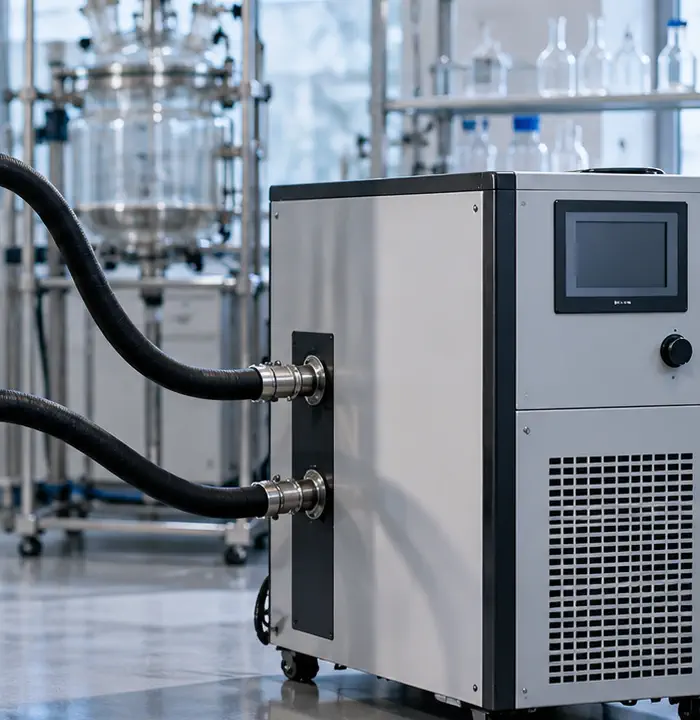
Figure 1. Editorial detail of a recirculating temperature-control unit and two insulated lines. Connection positions and operating limits must be confirmed for the purchased system.
4. Use a measured step test to locate the bottleneck
A useful commissioning trial changes one controlled variable at a time with a safe, representative test fluid. Start from a documented initial product temperature and a known working volume. Apply a defined setpoint change within the vessel and circulating-fluid limits, then log the bulk product temperature against the jacket supply and return readings when available. Repeat only after the system returns to a comparable initial condition.
The response curve can distinguish a fast jacket change with slow product response from a slow change at the circulator itself. If the jacket reaches a new condition but the product lags, examine mixing, working volume, circulation and the attainable driving temperature difference. If even the supply temperature cannot approach the requested value, review heating or refrigeration capacity and utility conditions first. These are diagnostic patterns, not proof of any one fault.
For a meaningful comparison between proposals, ask suppliers to state the test fluid, fill volume, starting temperature, intended final temperature, ambient conditions, mixing condition and how temperature was measured. A heating-time claim without those conditions cannot be carried reliably from a small demonstration vessel to a pilot unit.
5. Troubleshoot the symptom, not the number on the panel
| Observed behavior | Plausible mechanisms | Useful discriminating checks |
|---|---|---|
| Circulator stable; product heats slowly | Large thermal mass, limited circulation, weak internal mixing, small driving difference | Log bulk and jacket temperatures; verify working volume and agitation |
| Product overshoots after heating stops | Stored heat in jacket or vessel, control lag, probe response or position | Review supply temperature and cooling transition; verify probe immersion |
| Cooling worsens late in the batch | Viscosity increase, exothermic duty, insufficient cooling capacity or loop flow | Compare late-batch load with chiller duty and flow evidence |
| Different samples show different temperatures | Incomplete mixing, probe placement, stratification or transient feed effect | Check sampling method and mixing uniformity under safe conditions |
| Circulator struggles to achieve its own target | Utility load too high, loop restriction, ambient conditions or fluid choice | Check rated operating envelope and installed circuit before retuning |
The table is a starting point for an orderly investigation. Chemical reactions may be exothermic, sensitive to temperature or hazardous under vacuum; a diagnostic trial must not override interlocks, safe operating procedures or a qualified process-hazard review.
6. Set up heating and cooling as one working envelope
Heating duty and cooling duty need not be symmetric. A batch may heat slowly at start-up but demand strong cooling during a feed-driven exotherm. Conversely, a small reaction may require rapid chilling after a hold step while generating little heat during the main stage. The useful design basis therefore includes the full sequence: start temperature, heat-up target, allowable ramp rate, hold duration, heat released or absorbed, cooling target, and acceptable temperature excursion.
Review the chosen circulating fluid for its safe operating range, viscosity at low temperature, compatibility with seals and hoses, and any fire or toxicity hazards. Water and heat-transfer oils are not interchangeable across every requested temperature. Equipment compatibility, process medium and circulation fluid compatibility are separate questions; borosilicate construction does not exempt fittings, gaskets or coatings from verification.
Cooling-capacity claims should state the fluid and temperature at which capacity is available. The available duty of a recirculating chiller often changes materially with operating temperature. An apparently adequate nominal unit can become undersized near the cold end of the process. Insulation helps reduce ambient losses, but it does not create additional refrigeration capacity.
7. Confirm the vessel configuration before comparing quotes
A double-layer glass reactor circulates a thermal fluid through an external jacket surrounding the process vessel. It differs from a single-layer glass reactor heated by a separate bath or mantle. Both configurations may have practical uses, but the location of heat exchange, ease of cleaning, visibility, heat-up response and utility interfaces are not identical. The requested quotation should identify exactly which configuration is being supplied.
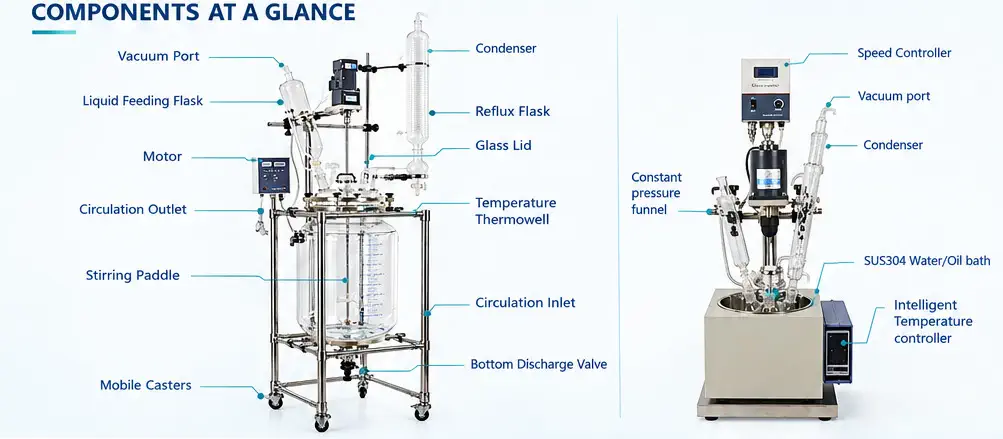
Figure 2. Equipment-configuration reference from existing OLLITAL glass-reactor material: a jacketed vessel and a separate bath-heated glass-reactor arrangement. Illustrative labels and accessories vary by quoted model.
The current OLLITAL glass-reactor catalog includes a small SF-series jacketed vessel family and a larger SF-series double-layer glass-reactor family. Their public descriptions refer to thermal-fluid circulation through the jacket. Product pages provide vessel-specific catalog information, but they do not establish a verified heat-up or cool-down performance curve for the buyer's particular reaction. Confirm actual working volume, usable temperature limits, glass and seal compatibility, agitation components, temperature-sensor position, hose ports and matched circulating-unit requirements before placing an order.
View the current OLLITAL small jacketed glass reactor range for a baseline product-family reference, then obtain a project-specific equipment drawing.
Review the OLLITAL larger double-layer glass reactor models when considering greater working volume or changes to mixing and thermal duty.
8. A better RFQ makes temperature performance comparable
Buyers often submit “20 L glass reactor, -10 to 120 C temperature control” and receive prices for quite different scopes. Temperature range alone does not define whether the reactor should complete a time-sensitive heat-up, remove a peak reaction load, or hold the bulk product within an acceptable band. At OLLITAL, we recommend sending a short process sheet covering the following engineering inputs.
Product and batch: liquid composition, nominal and minimum working volume, solids fraction, viscosity changes, heat capacity where known, and the intended operating pressure or vacuum. Temperature program: initial product temperature, target profile, allowed deviation, ramp-time expectation, holding duration and anticipated heat release. Mixing: impeller type, acceptable agitation window and any shear or solids-suspension requirements.
Utilities and installation: cooling-water or chiller availability, electrical supply, room temperature, allowable footprint, loop distance and fluid safety constraints. Equipment scope: vessel and circulator model, probes, thermal-fluid hoses and insulation, controls, venting and drain arrangements, drawings, commissioning responsibilities, documentation and spare parts.
Ask the supplier to distinguish catalog features from performance that requires a process trial. Where a product-temperature target is critical, agree on test conditions and acceptance criteria before purchase. A quotation that documents its assumptions is more useful than an attractive heating or cooling time without test context.
Questions that improve a supplier comparison
Can a thermostat setpoint be treated as the verified reactor temperature? No. Temperature-control unit readings describe the unit and its own sensor position. Verify bulk-liquid response with a calibrated, correctly immersed process probe during a representative trial. If the process is sensitive to small excursions, specify the measurement tolerance and logging interval before the test starts.
Will a more powerful circulator always shorten cooling time? Not if heat transfer through the jacket and vessel or internal liquid circulation is limiting. Review the available refrigeration duty at the intended working temperature, the actual jacket flow, the product viscosity and the difference between jacket and bulk temperatures. Oversizing without these checks may add cost without achieving the expected improvement.
Can the same recipe be transferred from a 5 L to a 50 L glass reactor? Not without engineering review. Different wall area per unit volume, fill level, circulation-loop resistance and mixing geometry can alter the product response. Maintain the biological or chemical process constraints and use measurements to revise the temperature program; never assume constant stirrer RPM or identical heating time is a scale-up rule.
9. The operating decision: control the product, not the display
Stable, reproducible temperature control in a jacketed glass reactor comes from matching the vessel, thermal-fluid circuit, mixing system and sensor strategy to the material and process. The critical evidence is a measured product-temperature response under a defined working load. An apparently poor result may stem from circulation or mixing rather than the controller; a seemingly perfect supply-temperature trace may hide an unsuitable product response.
If you are selecting a new system, we recommend documenting your most demanding heating or cooling step and discussing it before hardware is fixed. That is the best stage to review jacket connections, circulator sizing, agitation, probe locations and commissioning measurements together.
Need to review temperature-control performance for your project? Contact OLLITAL with the proposed vessel size, material properties and temperature profile to discuss a suitable reactor-and-circulator configuration.


