Food Retort Sterilization: Heat Penetration, Overpressure and Process Validation
2026-10-21 12:13:50Retort chamber temperature is not proof of product sterility
Industrial food retorts use controlled heating and cooling to process products sealed in appropriate packaging. The chamber can reach its temperature target while the slowest-heating region inside a pouch, can, jar or tray remains cooler. The distinction matters in equipment selection, scheduled-process development and batch-release decisions. It is possible to operate a retort with apparently steady instruments and still have an inadequately characterized product process.
At OLLITAL, we recommend separating three questions before comparing quotations: Can the equipment distribute its heating medium uniformly? Can the selected package and food reach the required validated thermal process? And can the unit control pressure and cooling without damaging the package? Each question calls for different evidence. No temperature or holding-time value in a machine brochure replaces a qualified, product-specific process determination.
1 | Define the product, package and thermal objective first
The design brief begins with the food: composition, acidity, viscosity, solids and particulates, fill weight, headspace and planned storage conditions. Then specify the packaging format and its sealing method. A rigid can, glass jar, flexible pouch and semi-rigid plastic tray may respond differently to heat transfer, pressure and motion. More viscous or particle-containing products may heat differently from a freely convecting liquid.
The objective also matters. A retort used for commercially sterile shelf-stable low-acid food operates under requirements distinct from a pasteurization step in a chilled product chain. Do not equate a generic “sterilization temperature” with a validated microbial lethality target. In markets where applicable, a qualified processing authority establishes the scheduled process using suitable scientific evidence and the critical factors specific to the food and container.
2 | Heat distribution versus heat penetration: two different studies
Heat distribution evaluates how uniformly the retort delivers heat to locations in its chamber under a defined loading arrangement, operating program and utility supply. It examines come-up behavior, circulation or fan performance where fitted, venting or air management, and possible cool regions in the equipment. Testing an empty chamber alone is generally not an adequate substitute for verifying the intended loaded configuration.
Heat penetration measures the time-temperature behavior at relevant locations within the packaged food. Its slowest-heating location depends on the product and packaging; it must be identified rather than presumed. A vessel control sensor and a logger placed within a package answer different questions. Package placement, product viscosity, particle distribution, fill mass and initial temperature may all affect the heating curve.
These studies are linked but not interchangeable. A well-distributed heating medium does not guarantee fast heat penetration into a dense product. Conversely, a heat-penetration run conducted in one position does not independently verify chamber uniformity. When requesting acceptance criteria, identify which study is required, by whom, and for what loading and product conditions.
3 | What changes between steam-air, water spray and water immersion
Steam-air retorts employ a controlled steam-and-air environment and usually depend on deliberate circulation to maintain heat distribution while allowing overpressure. Water-spray or water-cascade systems use recirculating heated water, with their own distribution, pump and nozzle considerations. Water-immersion systems expose the load to heated water and require assessment of flow, fill and circulation behavior. These are broad process families, not interchangeable recipes.
The choice affects heating-medium contact, pressure strategy, packaging compatibility, utilities and cleaning. For steam-air service, non-condensable gas distribution must be addressed in the validation plan; it is not safe to assume that any arbitrary air fraction will produce a uniform heating environment. For water-based systems, flow interruption, spray blockage or poor water distribution can create localized risks. Ask suppliers for the actual piping and instrumentation design rather than choosing by an attractive photograph.
4 | Overpressure protects packages; it does not create lethality
In overpressure retorting, chamber pressure can be controlled partly independently of the heating-medium temperature. This helps manage the difference between internal package pressure and external chamber pressure during heating and cooling. The pressure profile required depends on package construction, headspace, product temperature and sealing characteristics.
Insufficient external support can contribute to pouch swelling, seam stress or container deformation. Excessive external differential pressure can also damage certain flexible or semi-rigid packages. A pressure trace therefore needs to be evaluated against packaging performance, not treated as a stand-alone quality number. Operators should not adjust pressure curves by trial and error on commercial product: changes to critical conditions require a documented technical evaluation.
5 | Come-up, hold and cooling must be recorded as separate phases
A common source of confusion is when to begin counting scheduled holding time. The retort heating medium, product cold point and controller may reach the same nominal temperature at different times. The approved process defines how come-up and holding are handled; operators cannot simply subtract warm-up time or count an arbitrary interval at the control setpoint. Actual lethality evaluation uses time-temperature history and appropriate product-specific kinetics and assumptions.
Cooling is also an engineering phase. Cooling medium quality, temperature, rate and external pressure can affect both package integrity and recontamination risk. In some processes the packaged food continues to receive thermal exposure during early cooling, but no general calculation or safety credit should be assigned without a recognized process-evaluation method. Batch records need to reflect what actually happened, including alarms or interruptions, not only the intended program.
6 | Loading pattern and basket geometry are process variables
The number of containers, orientation, dividers, stacking pattern and spacing between baskets can alter heating-medium pathways. Flexible packages that sag or overlap may restrict flow. Large rigid containers can behave differently from shallow packages. Even when two baskets fit within the same retort, their heat-distribution effects need not be equivalent. A meaningful factory acceptance plan therefore includes the intended load or a defensible surrogate with documented limitations.
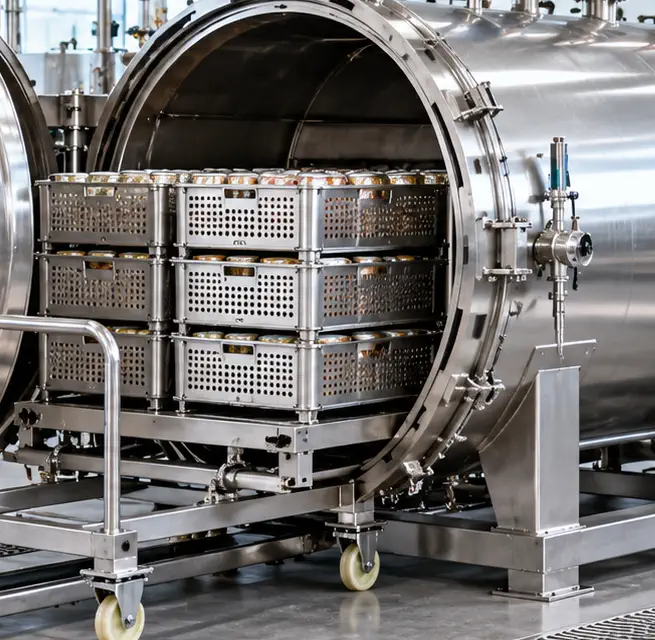
Figure 1 | Editorial close-up of a trolley with stacked perforated baskets. Basket spacing and load pattern can affect heating-medium flow and must be covered by the validated arrangement.
For the equipment quotation, provide drawings or photographs of each proposed basket, tray, spacer and container. Confirm whether the quoted capacity describes chamber volume, number of baskets or validated product throughput. These figures are not synonyms. More containers per load may lower unit handling cost but also change come-up and heat-transfer behavior if the configuration has not been tested.
7 | Build a measurement and validation plan before commissioning
For a new line, identify the applicable standards and the responsible qualified process authority early. The engineering test plan should identify representative or worst-case product variants, instrumentation accuracy, sensor calibration status, placement strategy, temperature distribution test matrix and relevant heat-penetration studies. Placement of probes inside packages may require special test methods; normal commercial package sealing and integrity must not be assumed to remain unchanged.
Thermal data must be traceable to the correct load, product, container size, fill and machine program. Where a critical limit is missed or an instrument fails, affected product should be identified and handled under the site deviation system pending competent evaluation. A screen showing a green completion symbol is an operator aid, not independent evidence that a process was safe or compliant.
| Observed issue | Possible engineering or process cause | First evidence to review |
|---|---|---|
| Retort reaches setpoint but product warms slowly | Dense product, cold initial fill, package geometry or insufficient load-side transfer | Product thermal study, fill conditions and load drawing |
| Temperature varies by basket position | Circulation / venting limitations, spray distribution, obstructions or load layout | Mapped chamber distribution study under relevant load |
| Pouches swell, wrinkle or seals are stressed | Pressure differential, package headspace or mismatched cooling curve | Package qualification and time-correlated pressure/temperature traces |
| Batch-to-batch time differs | Initial temperature, steam supply, water flow, sensor response or load variation | Utility trends and actual batch records |
| A sensor or controller log is missing | Instrument, recorder or data integrity failure | Calibration, alarms, independent records and deviation procedure |
8 | Examine control instruments and utility dependencies
Ask for the location and function of chamber temperature instruments, reference probes, pressure transmitters, circulation confirmation and relevant alarms. Verify that the proposed control system records the values needed for the product process, including how it identifies sensor faults, power loss, cycle interruptions and manual override. Calibration access and traceable records should be part of the acceptance discussion.
Utility specifications deserve equal attention. Steam quality and capacity, water flow and temperature, compressed air performance where applicable, electrical service, drainage and exhaust provisions can constrain actual cycle behavior. A nominal chamber volume or heating-power figure cannot compensate for insufficient site utilities. Where air-overpressure or water circulation is critical, the failure response should be defined before commissioning.
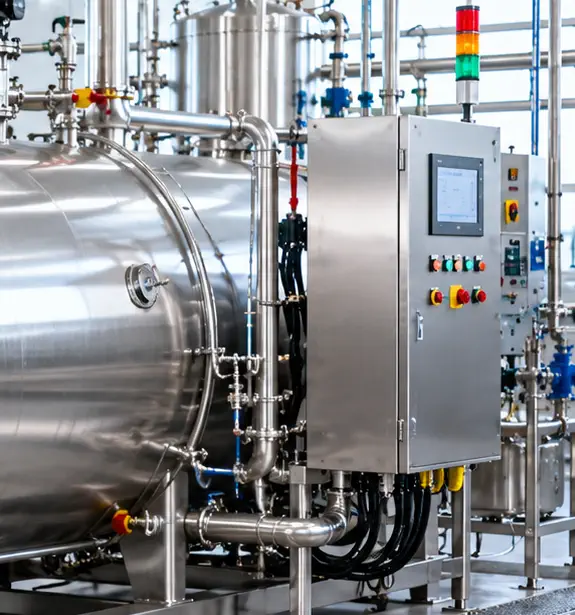
Figure 2 | Editorial detail of a retort control cabinet, piping and associated instruments. Positions and indicators are illustrative; verify delivered instrumentation from the approved equipment drawing.
9 | Compare retort quotations with an application-specific RFQ
A useful RFQ makes the supplier distinguish supplied machinery from the scientific validation and operating services that may be needed. OLLITAL currently lists steam-air retort equipment alongside water-bath / steam-spray variants and batch sterilizer products. Those pages demonstrate the available equipment families; they do not establish a scheduled process for the buyer’s food or prove a particular packaging format has already been validated.
| Buyer specification | Confirmation requested in the quotation |
|---|---|
| Product and packaging envelope | Container types/sizes, fill limits, pH or product classification, load drawings |
| Thermal processing medium | Steam-air, spray/cascade or immersion; circulation and control configuration |
| Overpressure strategy | Pressure-control capability, alarms, cooling response, package test requirements |
| Recorded process data | Temperature/pressure channels, recording, calibration and export capability |
| Load handling | Basket count, carriage interface, clearances and service access |
| Engineering acceptance | FAT/SAT scope, test instruments, validation responsibilities and deliverables |
10 | What commissioning should prove, and what it cannot
A practical commissioning sequence checks mechanical and electrical integrity, safety interlocks, pressure-boundary condition, utilities, instrument calibration and repeatable program execution. Then the processor and its qualified specialists determine the tests required for heat distribution, product heat penetration and safe scheduled-process establishment. The degree of testing depends on equipment design, jurisdiction, product hazard and packaging.
An equipment vendor can supply mechanical data, P&IDs, utility specifications, control records and functional tests, but should not claim that a generic water run proves commercial sterility for every future formulation. Equally, a processing authority cannot evaluate an unrecorded product temperature history from a brochure figure. Specify responsibilities and records in the purchase order so that the eventual process handover is auditable.
Conclusion: buy a controlled process platform, not a temperature claim
Retort selection succeeds when chamber heat distribution, the product’s slowest-heating condition, package pressure integrity and batch documentation are treated as linked but separately demonstrated requirements. A well-defined system reduces avoidable commissioning surprises and makes later product changes easier to evaluate without assumptions about microbial safety.
At OLLITAL, we recommend sharing the packaging format, product category, expected load pattern, utility conditions and required validation scope before finalizing a retort configuration. Our team can discuss the available equipment arrangement and quotation boundaries while the processor’s qualified specialists establish the product-specific scheduled process.
Explore the OLLITAL steam sterilization series, compare the steam-air retort equipment page and the water-bath retort option when defining the mechanical scope.
Planning a new packaged-food retort line? Share the container format, load drawing and validation expectations with OLLITAL to begin a technical configuration review.


