Tubular UHT Sterilizer Selection: Holding Time, Fouling, CIP and Heat Recovery
2026-10-20 14:38:27A practical engineering guide for buyers assessing continuous liquid thermal-processing systems
A capacity number cannot describe the whole sterilization process
A tubular UHT system may be quoted in liters per hour, yet the hourly throughput alone does not tell a food or beverage producer whether the selected line can deliver the required treatment. The product must reach the intended thermal condition, remain there for an adequately established residence time, and travel through a downstream system that protects it from recontamination. All of that must remain manageable while the liquid changes in viscosity, deposits material on heated surfaces, and undergoes repeated cleaning cycles.
At OLLITAL, we recommend evaluating a tubular UHT sterilizer as a connected process, not just a stainless-steel heat exchanger. A useful quotation should relate product properties to the heating method, holding section, permitted flow, fouling behavior, cleaning concept, utilities, control response and filling interface. The right questions are specific enough to distinguish an achievable process from an attractive catalog photograph.
1. Clarify the product before specifying the machine
Two products with the same hourly flow can place very different demands on a tubular heat exchanger. Milk, juice, plant-based beverages, syrups and suspensions differ in composition, viscosity, acidity, solids, particle size, tendency to foam, sensitivity to cooked flavors and thermal stability. The formula may also change across a production season or after upstream homogenization. A supplier needs the realistic range, not only a single ideal recipe.
Start the inquiry with product name and composition, temperature at entry, target output temperature, minimum and maximum flow, viscosity at relevant temperatures, particle or fiber distribution, operating pressure constraints and expected continuous production duration. Distinguish a laboratory recipe from the worst-case production formulation. Large particles, fibrous ingredients or high viscosity may require a different tube arrangement, pump or processing strategy; the word “tubular” alone does not establish suitability.
2. Holding time is linked to actual flow, not a screen setting
The holding section provides controlled residence at the specified treatment temperature. As a first screening relationship, nominal residence time equals the liquid-filled volume of the holding section divided by volumetric flow at the relevant process condition. If the same tube is run at higher flow, nominal time becomes shorter. Simply selecting a higher production rate on the control panel cannot preserve treatment exposure without a compatible process design.
Nominal holding time is not automatically the minimum exposure of every fluid element. Velocity profiles, flow regime, temperature distribution, viscosity, any particles, and the position of measuring points can matter. Appropriate process validation must address the fastest-moving portion where required, as well as the product-specific microbial objective and applicable market rules. Do not apply a generic temperature-time recipe from another product without evaluating its microbiological and quality basis.
For an RFQ, ask for the holding-section internal diameter and effective length or volume, design flow range, the method used to establish minimum holding time, locations of temperature sensors and the actions taken when flow or temperature moves outside approved conditions. The supplier should also explain whether nominal capacity is quoted at the actual product viscosity and thermal conditions or merely with water.
3. Follow the temperature history through the entire line
A sensible indirect UHT arrangement may preheat incoming liquid, use a final heating section, pass through a holding tube, then cool the product through regenerative and final cooling stages. The actual sequence depends on the process design. Its thermal history influences product quality as well as treatment effectiveness: excessive residence at elevated temperatures can promote changes in flavor, protein structure, color or other properties.
Review the control philosophy at startup, at stable operation, after a short interruption and during shutdown. The temperature displayed at one point is not proof that the entire stream followed the required time-temperature path. A deviation may require flow diversion, flushing, process review and a validated restart procedure rather than simply resetting an alarm. The correct safeguards and acceptance criteria depend on the food safety plan, design and local regulation.
4. Tube arrangement affects heating, pressure drop and particle handling
Tubular exchangers can be configured using single or multiple product tubes, different flow paths and multiple modules. Flow velocity influences heat-transfer performance and wall shear, while tube diameter and product rheology influence the pressure needed to move the fluid. Smaller passages can improve some aspects of heat transfer but can increase pressure loss or clogging risk with particulates. Larger passages can better accommodate certain products yet may require additional heat-transfer area or different flow management.
Buyers should request a basic process and instrumentation diagram (P&ID), product-side flow path, cleanable internal geometry and a pressure-drop estimate at representative viscosity. If the product contains particles, confirm allowable size, integrity requirements and whether the chosen process has a validated treatment strategy for the particles as well as the carrier liquid. A generic “suitable for juice” label is not enough.
5. Fouling changes performance during the production run
Heat transfer conditions at a clean startup are not the same as after several hours of heating a protein-, mineral- or solids-containing product. Deposits can add resistance to heat transfer, increase pressure drop and force the control system to work harder. Depending on the formulation, thermal denaturation, mineral deposition, concentration effects and other mechanisms may contribute. A short successful test with clean water does not demonstrate the expected run length with the intended product.
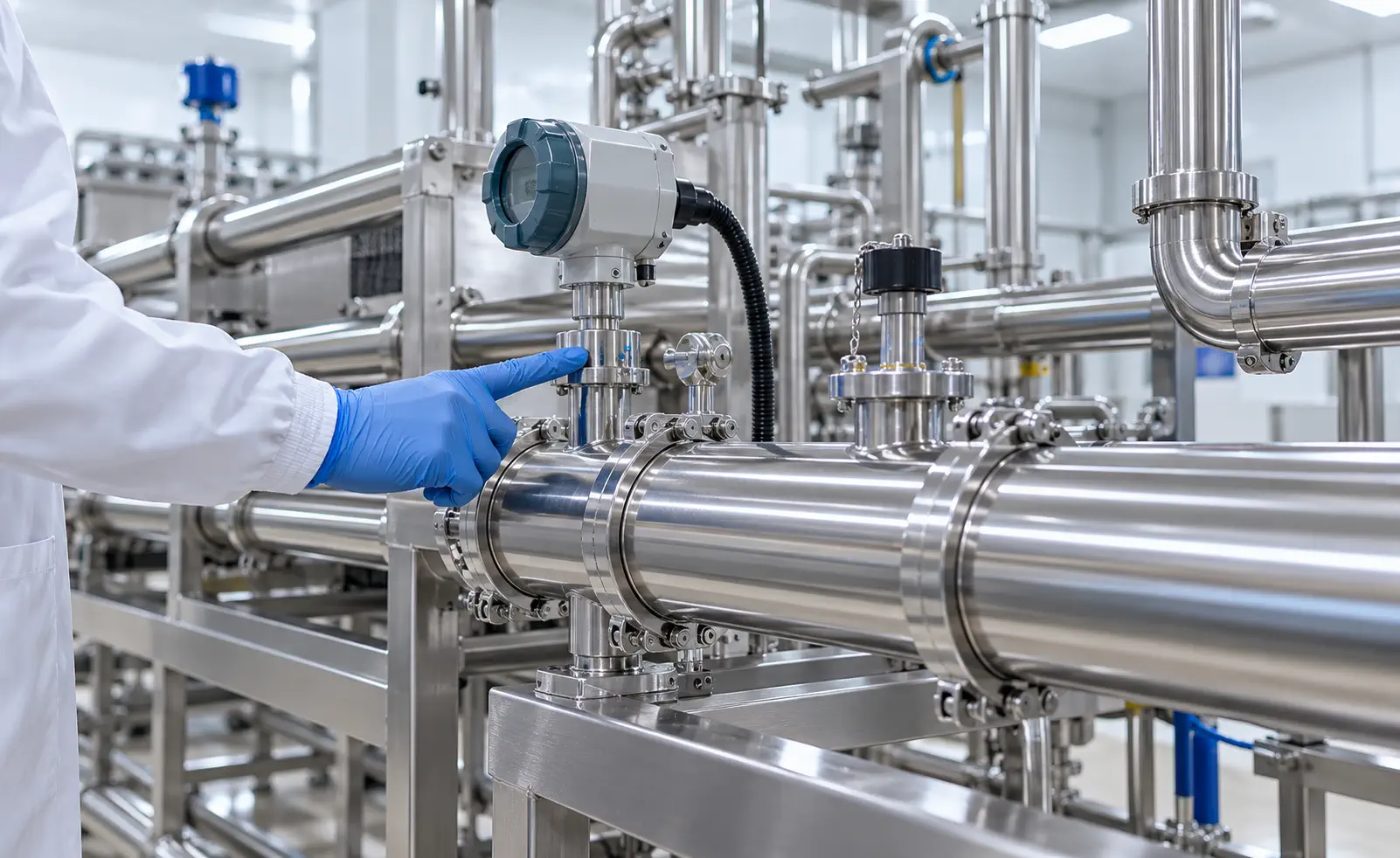
Figure 1. Illustrative process instrumentation at sanitary piping. Actual temperature and pressure-sensor placement must follow the approved piping design.
The troubleshooting evidence should be trended as a group: product inlet and outlet temperatures, heating-medium duty, flow, pressure difference across sections, pump load, and cleaning frequency. A gradual increase in pressure loss combined with reduced heat-transfer response points toward a different investigation than an isolated sensor failure. The goal is not to label every deviation as fouling, but to capture enough data to distinguish competing causes.
What to ask about running time
Ask which products and operating conditions underpin the supplier’s proposed uninterrupted run length. If performance testing is offered, agree in advance on the feed material, accepted pressure-drop increase, thermal stability criteria, expected product losses and the trigger for cleaning. A credible comparison states the assumptions and limits; it does not promise a universal number of hours between cleaning cycles.
6. CIP, SIP and hygienic design must be considered separately
Clean-in-place (CIP) circulates suitable cleaning liquids through equipment without dismantling every process-contact part. Steam-in-place (SIP) or another sterilization procedure addresses a different requirement and must not be treated as a substitute for removing deposits. Whether a line requires a validated SIP step depends on the process and downstream hygienic or aseptic design. The presence of a “CIP/SIP” statement in a listing should trigger detailed configuration questions, not close them.
Cleaning effectiveness depends on reaching all product-contact paths with the correct chemistry, circulation conditions, temperature and contact time. Pay special attention to parallel flow paths, instruments, valve seats, gaskets, dead legs and areas where drains do not self-empty. A return-line conductivity trace alone cannot prove every surface is clean. The acceptance method should reflect the product, risk assessment and relevant plant procedures.
Operating concern | What should be checked | What the observation cannot prove |
|---|---|---|
Temperature excursion | Sensor location, flow, control valve response and recorded deviation handling | One normal display reading does not validate treatment history |
Rising differential pressure | Product viscosity, deposits, tube routing, valves and pump performance | Pressure rise alone does not identify the deposit chemistry |
Frequent CIP | Soil load, chemistry, contact coverage, rinse quality and cleaning verification | A completed automated cycle is not proof of cleanliness |
Unstable throughput | Feed tank level, gas entrainment, pump curve, backpressure and flowmeter | Nominal pump capacity is not necessarily process capacity |
7. Heat recovery is useful only when the complete duty is understood
In a regenerative section, outgoing hot product can preheat incoming cooler product through a heat-transfer surface. That can reduce heating and cooling utility demand, but the benefit depends on product temperatures, heat-exchanger arrangement, fouling state, flow stability and losses elsewhere in the line. The achievable saving should be supported by a mass-and-energy balance for the proposed product and throughput, not by an unqualified percentage printed on a brochure.
The selection review should also consider pressure hierarchy, leak detection where required, and how the chosen configuration limits unacceptable mixing of streams if a barrier fails. The relationship between raw and treated streams is especially important in hygienic process design. Ask for utility use at representative duty points and clarify whether the quotation includes regeneration, final cooling, controls and the supporting pumps.
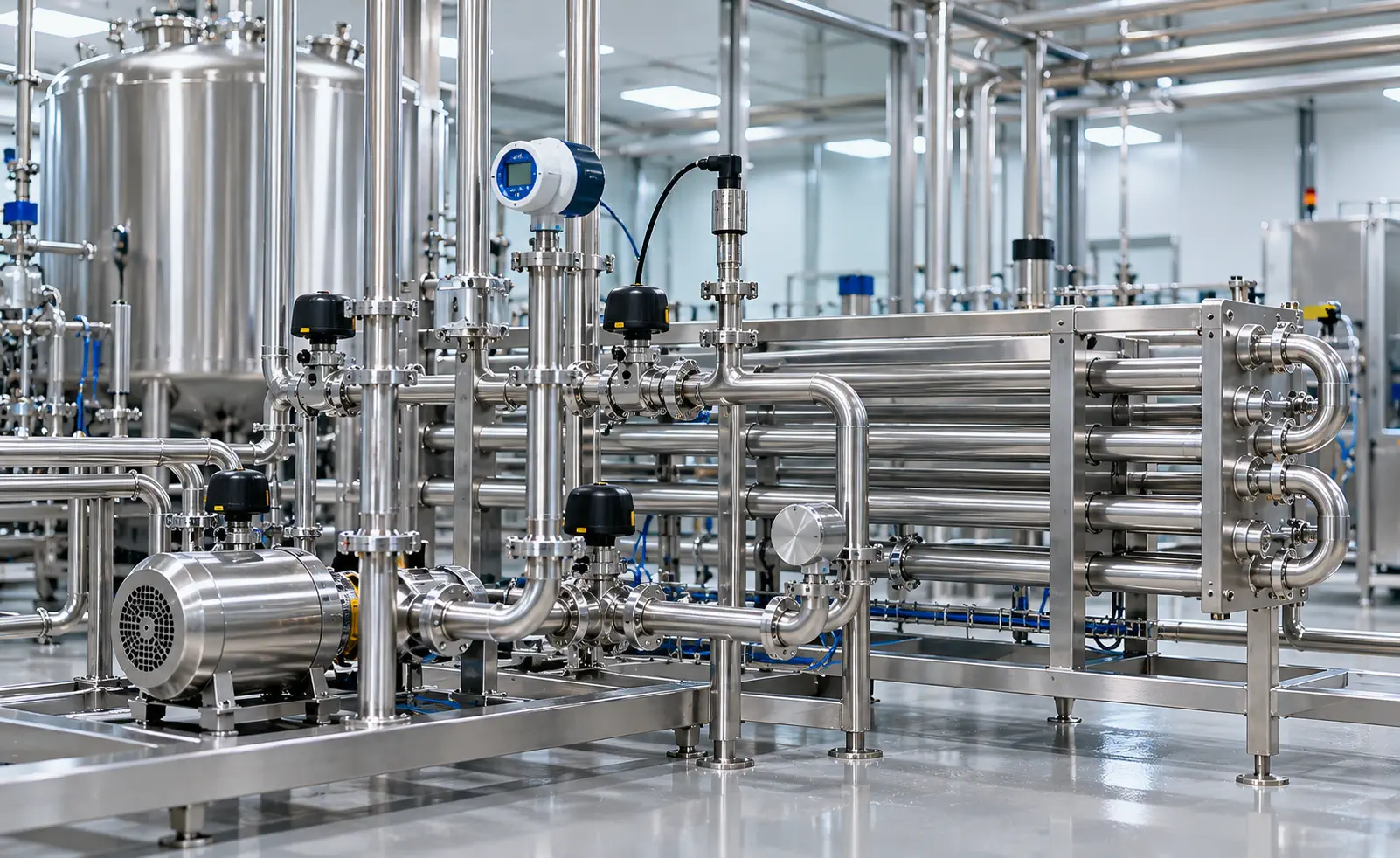
Figure 2. Illustrative sanitary-processing skid with tubular sections, pumps and valve assemblies. Mechanical arrangement is conceptual rather than a model-specific equipment drawing.
8. Aseptic operation depends on equipment beyond the heating section
A UHT treatment unit is only one part of an ambient-stable product system. The downstream product path, sterile buffer or holding vessel where used, filling technology, package integrity, cleaning and start-up practices must support the stated product-life objective. Heat treatment by itself does not make an open downstream transfer or a non-aseptic packaging step sterile. The meaning of commercial sterility and the required evidence must be defined for the market and product.
For process qualification, ask who is responsible for the interfaces between the heating skid and the filler or storage tank. Clarify sterile barriers, allowed operating interruptions, instrument calibration, alarm records and what happens to product in the line during a deviation. The exact compliance approach belongs to the plant’s validated food safety and quality system.
9. What the OLLITAL product pages show - and what to reconfirm
OLLITAL’s published tubular sterilization range includes automated systems marketed for liquid products such as milk and juice. One tubular UHT product listing describes PLC/HMI operation, stainless-steel contact equipment, CIP/SIP-related functions and heat recovery. These are useful starting points for a configuration discussion, but a page listing is not a qualification report and does not establish that every option is fitted to every quoted line.
For product-family context, review our Tubular Sterilization Equipment category and the Automatic Tubular UHT Sterilizer listing. A multi-tube processing configuration is also presented on the site; the exact scope, process limits and line integration should be reconfirmed for the quoted model.
At quotation stage, request up-to-date drawings, the product-contact materials and surface-finish requirements, included instrumentation, pump selection, utilities, cleaning arrangement and a description of the test evidence available. Do not infer validated lethality, product shelf life, total installed power or guaranteed savings from a general product description.
10. Send the engineering details that make supplier offers comparable
A strong inquiry is concise but specific. We recommend documenting the following before asking suppliers to propose heat-exchanger geometry or equipment capacity:
Product profile: formulation or representative samples, solids, acidity, viscosity versus temperature, gas content and largest relevant particles.
Treatment requirement: intended market, target organism or microbiological objective, validated processing concept, product quality limits and any existing process evidence.
Production scope: minimum and nominal hourly throughput, operating schedule, temperature of feed, seasonal variation and expected uninterrupted run time.
Utility and layout conditions: available steam or hot-water duty, chilled or cooling water, electrical supply, floor space, pipe routing and drainage.
Controls and hygiene: accepted flow/temperature monitoring, alarms, diversion philosophy, cleanability evidence, CIP supply, and downstream filling interface.
Commercial scope: FAT/SAT expectations, documentation, spare parts, installation responsibilities, trial material, commissioning and training.
The procurement decision: select for the real product, not maximum flow
The best tubular UHT configuration is not necessarily the one advertising the largest liters-per-hour figure. A defendable selection matches the heating and holding strategy to the product, preserves sufficient process margin as fouling develops, supports a realistic cleaning plan, and makes upstream and downstream responsibilities clear. When those questions are resolved early, equipment comparisons become easier and start-up surprises become less likely.
At OLLITAL, we suggest sharing the product brief and any pilot or current production data before finalizing the heat exchanger and controls. That allows our team to discuss the intended temperature history, pressure losses, cleaning requirements, utility package and documentation scope against an actual use case.
Planning a tubular UHT line for milk, juice or another pumpable liquid? Send OLLITAL your product properties, target capacity and process constraints through Contact OLLITAL so the proposed configuration can be evaluated on the right technical basis.


